What Is a Recruiter? Types, Tasks, and How to Become One
Learn more about the different types of internal and external recruiters, what they're responsible for, what you'll need to be successful in this role, and how to become one.
![[Featured image] A recruiter speaks with two job candidates in an office.](https://d3njjcbhbojbot.cloudfront.net/api/utilities/v1/imageproxy/https://images.ctfassets.net/wp1lcwdav1p1/6UhScUhJVaNbERxu1OMzx8/4504b82fc830cc94faa0e468116f1b1f/GettyImages-1124741491.jpg?w=1500&h=680&q=60&fit=fill&f=faces&fm=jpg&fl=progressive&auto=format%2Ccompress&dpr=1&w=1000)
Key takeaways
A recruiter is a human resources professional primarily responsible for searching for and screening candidates qualified to fill job openings within an organization.
As a recruiter, you'll also handle job postings and salary negotiations, and work with hiring managers to ensure a good fit for both parties.
In this role, it's also important to stay up-to-date on job trends, industry outlooks, and the qualities and skills companies are looking for when hiring new employees.
Learn more about the different types of recruiters, what this role is responsible for, and how to become one. Afterward, build your recruiting skills with the ADP AIRS® Entry-Level Recruiter Professional Certificate.
What is a recruiter?
Recruiters essentially serve as matchmakers in the employment world, connecting the right talent with the right opportunities while helping both parties navigate the hiring process efficiently.
To be a successful recruiter, it's useful to have good relationship-building skills, including active listening and communication. Recruiters must also be able to quickly evaluate a candidate's qualifications, potential, and cultural fit through interviews and interactions.
Types of recruiters: internal vs. external
In the field of human resources, there are various recruiter roles to consider. Each type of recruiter plays a unique role in the hiring process, offering distinct advantages depending on the specific needs of the employer and the job market. The specific type of recruiter role that's right for you will depend on your interests, skills, and career goals.
Internal recruiters
Internal recruiters may also be known as corporate recruiters or in-house recruiters. They are full-time employees working within a company's HR department. In this role, you gain a deep understanding of the company culture, values, and goals, and your focus is on attracting top talent to fill open positions within the organization you work for.
External recruiters
External recruiters, sometimes referred to as third-party or agency recruiters, are hired by companies on a project or contingency basis, or they work for a recruitment agency to find qualified candidates. As an external recruiter, you can specialize in one of the following roles:
Executive recruiter: Find candidates to fill high-level executive positions, such as C-suite and senior management roles
Outplacement recruiter: Assist displaced workers who may have been downsized or laid off and who need help polishing their resumes and skills
Contingency recruiter: Get paid only if you successfully place a candidate in a job
Retained recruiter: Works exclusively with a company for a set period to find candidates for a specific high-level position and typically charges a retainer fee upfront, regardless of whether the role is filled
Technical recruiter: Use a strong understanding of technical skills to find qualified candidates for technical jobs in fields like engineering, IT, and software development
Specialized recruiter: Focus on filling jobs in a particular industry, such as health care, finance, or legal, using an in-depth knowledge of the specific skills and experience required for those industries
Bilingual recruiter: Can speak and understand multiple languages, which is valuable for companies looking to hire internationally or for positions that require fluency in multiple languages
Temp agency recruiter: Works for staffing agencies to fill the short-term needs of various companies
What does a recruiter do?
Recruiters help source candidates and find applicants to fill positions across industries. As a recruiter, your job duties can vary depending on the company you work for and the individuals that need to be matched. However, some typical recruiter tasks and responsibilities you'll likely undertake include:
Writing and posting job openings
Finding and contacting potential job candidates
Pre-screening job candidates
Presenting candidates to employers or hiring managers
Setting up interviews between candidates and employers
Negotiating salaries, responsibilities, and titles
How much do recruiters make?
According to Glassdoor, the average total pay for a recruiter is $113,000 [1]. Learn more about the different factors that can increase your salary as a recruiter. The growth for this role is expected to be steady over the next decade, with the US Bureau of Labor Statistics (BLS) predicting that HR specialist jobs, including those of recruiters, are projected to grow by six percent between 2023 and 2033 [2].
What is the difference between a recruiter and a hiring manager?
A recruiter specializes in finding talented professionals to join a team, regardless of which department or area within the organization the vacant position may be located. A hiring manager typically focuses on working for and leading their specific team within an organization, and joins the hiring process toward the end when selecting a qualified candidate for an open position. Essentially, the hiring manager is the individual who actually determines whether to offer the candidate a position.

How to become a recruiter
When you work as a recruiter, you’ll connect people to jobs that fit their interests and passions and help companies find employees to help achieve their goals. You’ll have the chance to meet people from all walks of life and get an inside look at several different industries. If this sounds like a good fit for you, here's how to get started.
Consider a degree.
Sixty-nine percent of recruiters hold a bachelor’s degree, nine percent hold a master’s degree, and 12 percent hold an associate degree [3]. An analysis from Zippia of over 81,000 recruiter resumes found the following breakdown regarding degrees commonly held by recruiters:
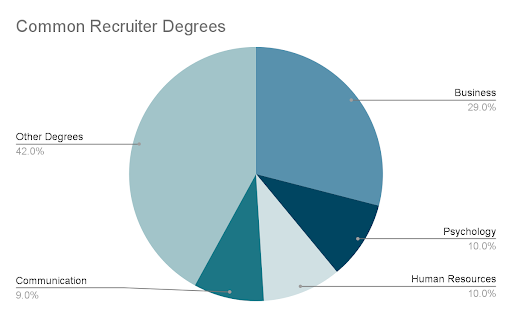
If a degree is not in your plans, you may consider earning a recruiter certification to gain the knowledge and skills that will be important to this career.
Can I be a recruiter without a college degree?
Though a bachelor’s degree can make you stand out against other candidates, it’s not always a requirement. Some employers can waive a college degree requirement if you have a few years of work experience in a related field. Look for entry-level recruiter openings or related office roles like administrative assistants to get started.
Build your skill set.
Build and strengthen key skills you'll need to be successful as a recruiter. These include:
Interviewing skills are critical because recruiters need to conduct phone and in-person interviews with prospective employees for job openings.
Negotiating skills are important because recruiters need to be able to work effectively with both the hiring manager and the potential candidate to secure a fair salary, job title, and job responsibilities.
Persuasive skills are essential for recruiters to convince candidates to consider an opening or an offer. A recruiter often has to persuade a hiring manager to interview a potential candidate for a job opening as well.
Human resources knowledge includes a broad scope of valuable skills, such as knowing how to manage, onboard, and incentivize employees and give performance appraisals.
Learn key tools.
Familiarize yourself with some of the popular tools recruiters use, such as applicant tracking systems (ATS) like Workday or Greenhouse. Practice using free versions of recruiting tools and complete online courses or certifications in recruiting software to build technical proficiency that employers value.
Gain experience.
Many recruiting positions require previous work experience in fields such as human resources, sales, operations, research, administration, or administrative support. Because understanding the industry and job market for which you are recruiting is an essential part of the role, an educational background in the specific industry you are interested in working in may also be beneficial.
Apply to jobs and practice interview questions.
Target entry-level recruiting positions such as recruiting coordinator, talent acquisition assistant, or junior recruiter roles at staffing agencies, which often provide excellent training opportunities. Prepare for common recruiting interview questions about relationship-building, handling rejection, prioritizing multiple searches, and examples of how you've successfully matched people to opportunities in previous roles or volunteer experiences.
Build your recruiting skills on Coursera
Whether you want to develop a new skill, get comfortable with an in-demand technology, or advance your abilities, keep growing with a Coursera Plus subscription. You’ll get access to over 10,000 flexible courses.



Article sources
1. Glassdoor. “Salary: Recruiter in United States, https://www.glassdoor.com/Salaries/recruiter-salary-SRCH_KO0,9.htm.” Accessed December 1, 2025.
2. US Bureau of Labor Statistics. “Human Resources Specialists: Occupational Outlook Handbook, https://www.bls.gov/ooh/business-and-financial/human-resources-specialists.htm.” Accessed December 1, 2025.
3. Zippia. "Recruiter Education Requirements, https://www.zippia.com/recruiter-jobs/education/." Accessed December 1, 2025.
Coursera Staff
Editorial Team
Coursera’s editorial team is comprised of highly experienced professional editors, writers, and fact...
This content has been made available for informational purposes only. Learners are advised to conduct additional research to ensure that courses and other credentials pursued meet their personal, professional, and financial goals.