Image Processing Courses
Image processing courses can help you learn image enhancement, filtering techniques, and object recognition. You can build skills in color correction, noise reduction, and feature extraction. Many courses introduce tools like OpenCV and MATLAB, that support applying these techniques in practical scenarios, such as developing applications for facial recognition or image segmentation.
Popular Image Processing Courses and Certifications
 Status: Free Trial
MathWorks
Skills you'll gain: Image Analysis, Matlab, Computer Vision, Spatial Data Analysis, Digital Signal Processing, Geospatial Information and Technology, Quantitative Research, Algorithms
Skills you'll gain: Computer Vision, Jupyter, Convolutional Neural Networks, Transfer Learning, Classification Algorithms, Cloud Deployment, IBM Cloud, Deep Learning, Visualization (Computer Graphics), Logistic Regression
 Status: Free Trial
Skills you'll gain: Image Analysis, Image Quality, Matlab, Computer Vision, Traffic Flow Optimization, Automation, Digital Signal Processing, Anomaly Detection, Spatial Data Analysis, Geospatial Information and Technology, Medical Imaging, Spatial Analysis, Data Preprocessing, Quantitative Research, Algorithms, Data Store
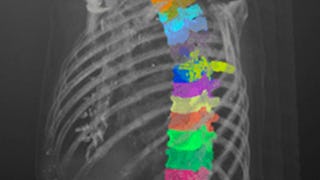 Status: Preview
MathWorks
Skills you'll gain: Medical Imaging, Magnetic Resonance Imaging, Image Analysis, X-Ray Computed Tomography, Data Import/Export, Biomedical Engineering, Matlab, Scientific Visualization, Deep Learning
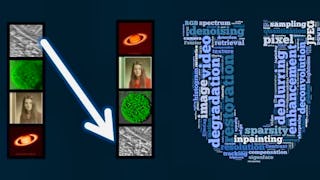 Status: Preview
Northwestern University
Skills you'll gain: Digital Signal Processing, Image Analysis, Computer Vision, Visualization (Computer Graphics), Matlab, Mathematical Modeling, Color Theory, Applied Mathematics
 Status: Free Trial
MathWorks
Skills you'll gain: Computer Vision, Model Evaluation, Image Analysis, Model Deployment, Anomaly Detection, Convolutional Neural Networks, Transfer Learning, Deep Learning, Image Quality, Data Preprocessing, Artificial Neural Networks, Matlab, Applied Machine Learning, PyTorch (Machine Learning Library), Machine Learning Methods, Machine Learning, Classification Algorithms, Artificial Intelligence and Machine Learning (AI/ML), Traffic Flow Optimization, Data Visualization
What brings you to Coursera today?
 Status: Free Trial
Skills you'll gain: Data Import/Export, Programming Principles, Web Scraping, File I/O, Python Programming, Jupyter, Data Structures, Data Processing, Pandas (Python Package), Data Manipulation, JSON, Computer Programming, Restful API, NumPy, Object Oriented Programming (OOP), Scripting, Application Programming Interface (API), Automation, Data Analysis
 Status: Free Trial
DeepLearning.AI
Skills you'll gain: Natural Language Processing, Supervised Learning, Transfer Learning, Recurrent Neural Networks (RNNs), Markov Model, Embeddings, Text Mining, Dimensionality Reduction, Machine Learning Methods, Statistical Machine Learning, Artificial Neural Networks, Classification Algorithms, Data Preprocessing, PyTorch (Machine Learning Library), Deep Learning, Tensorflow, Feature Engineering, Applied Machine Learning, Algorithms, Keras (Neural Network Library)
 Status: Free Trial
Vanderbilt University
Skills you'll gain: Prompt Engineering, Image Analysis, Data Visualization Software, File I/O, Matlab, Algorithms, User Interface (UI), Applied Machine Learning, ChatGPT, Scatter Plots, Object Oriented Programming (OOP), Digital Signal Processing, Mathematical Software, Computer Programming, Histogram, Predictive Modeling, AI Personalization, Data Processing, Data Analysis, Programming Principles
 Status: Preview
Skills you'll gain: Digital Signal Processing, Image Analysis, Computer Vision, Computer Graphics, Visualization (Computer Graphics), Medical Imaging, Spatial Analysis, Linear Algebra, Matlab, Mathematical Modeling, Histogram
 Status: Free Trial
Columbia University
Skills you'll gain: Computer Vision, Image Quality, Image Analysis, Computer Graphics, 3D Modeling, Photography, Virtual Reality, Visualization (Computer Graphics), Medical Imaging, Artificial Neural Networks, Unsupervised Learning, Graph Theory, Dimensionality Reduction, Mathematical Modeling, Estimation, Machine Learning Algorithms, Color Theory, Algorithms, Automation Engineering, Electronic Components
 Status: Free Trial
DeepLearning.AI
Skills you'll gain: Convolutional Neural Networks, Recurrent Neural Networks (RNNs), Computer Vision, Transfer Learning, Deep Learning, Image Analysis, Hugging Face, Natural Language Processing, Artificial Neural Networks, Artificial Intelligence and Machine Learning (AI/ML), Tensorflow, Applied Machine Learning, Embeddings, Supervised Learning, Keras (Neural Network Library), Machine Learning, Debugging, Performance Tuning, PyTorch (Machine Learning Library), Data Preprocessing
Searches related to image processing
In summary, here are 10 of our most popular image processing courses
- Introduction to Image Processing: MathWorks
- Introduction to Computer Vision and Image Processing: IBM
- Image Processing for Engineering and Science: MathWorks
- Medical Image Processing: MathWorks
- Fundamentals of Digital Image and Video Processing: Northwestern University
- MathWorks Computer Vision Engineer: MathWorks
- Python for Data Science, AI & Development: IBM
- Natural Language Processing: DeepLearning.AI
- MATLAB Programming for Engineers and Scientists: Vanderbilt University
- Image and Video Processing: From Mars to Hollywood with a Stop at the Hospital: Duke University










